
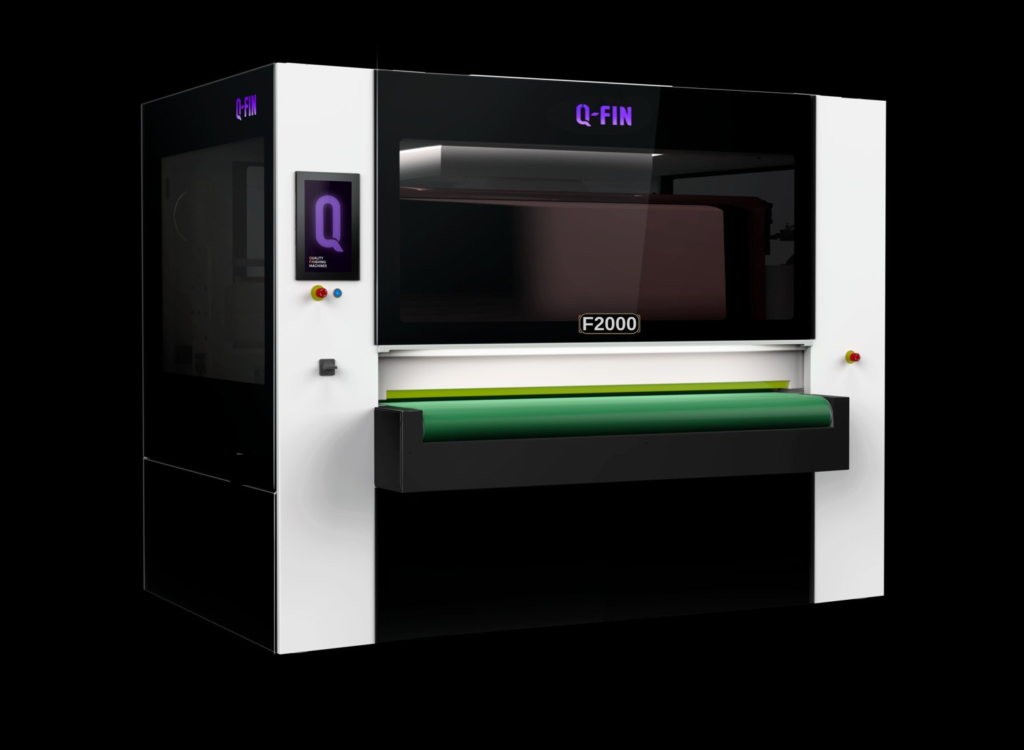
For more than a decade, Q-Fin has built its reputation on a simple idea, that the finishing step at the end of sheet metal production shouldn’t be the slow, manual, inconsistent bottleneck it has always been. With the launch of the F2000, the newest and widest machine in the company’s flagship F-Line, Q-Fin extends that philosophy to the largest cut parts on the shop floor.
The F2000: a bigger canvas, the same fast finish
The new F2000 pushes that envelope to 2000 mm, making it the widest all-round finishing machine Q-Fin has ever offered.
That extra width matters more than it might sound. Fabricators working with large enclosures, structural panels, heavy brackets, and oversized laser- or plasma-cut blanks have often had to split work across passes, reorient parts, or fall back on manual finishing for anything that wouldn’t fit a standard-width machine. The F2000 is built to take those large parts in a single pass, with the same throughput speed and repeatable quality that the rest of the F-Line is known for.
Crucially, the F2000 isn’t a different kind of machine, it’s the F-Line architecture scaled up. So everything that makes the smaller models fast and consistent carries over directly.
How the F-Line works
The F-Line is Q-Fin’s “all-round” finishing platform: one machine that deburrs, rounds edges, and finishes sheet metal parts in a single automated pass. The layout is consistent across the range.
The F2000 is equipped with two sets of four oscillating disc brushes that apply light, controlled pressure. Because the brushes oscillate, they round all edges and holes evenly across both inner and outer contours, rather than just the leading and trailing edges. The result is a uniform finish on the whole part, not just where it’s easy to reach.
Depending on the material and application, the machine can be configured with either vacuum or magnetic product fixation. Vacuum suits a broad range of materials and smaller parts, while the magnet version is aimed at steel and holds parts securely as they move through the machine.
A few capabilities define the platform:
- Automatic brush calibration: As brushes wear, the machine compensates automatically, keeping the finish consistent and precise from the first part to the last, without an operator having to dial settings back in.
- Self-adjusting stations: The machine adapts to the job rather than forcing the operator to set up each run by hand.
- Intuitive, multilingual touchscreen (HMI): Operators switch between finish programs on a large modern touchscreen, which keeps quality reproducible and minimizes the operator errors that come with manual setup.
- ERP-integrated workflows: Full ERP control means the F-Line drops cleanly into automated production environments rather than sitting off to the side as a standalone step.
Where the F-Line fits in the wider Q-Fin range
The F-Line is the versatile middle of a much broader catalog. Q-Fin organizes its machines into several lines, each aimed at a different finishing need:
- SER-Line (Super Edge Rounder): The most versatile edge-rounding finish machines, built around a dual-brush system with automatic brush calibration for consistent, reproducible results.
- F-Line (All-Round Finishing): Speed meets precision; the all-rounders that deburr, round, and finish in one pass. This is where the F2000 now sits as the flagship for width.
- FS-Line (Small Parts Finishing): The same finishing approach engineered for small parts, like the F250.
- M-Line (Multibrush Finishing): Multibrush machines for non-directional finishing, with the ability to safely process foil-covered sheets.
- FLEX-Line (Semi-Automatics): Flexible, ergonomic semi-automatic machines such as the TopGrinder (often described as the best hand-operated finishing machine in the world), the budget-friendly ProGrinder, the TopEdge milling table, and the Skipjoint for microjoint removal.
- DS-Line (Deslagging): Machines that use magnetic part fixation for fast, effortless slag removal, ready for inline integration.
- WES (Wet Extraction System): Wet dust extraction that eliminates fire and explosion hazards while maintaining constant suction power.
On top of the machines themselves, Q-Fin builds a full range of handling and automation solutions (QHS), including the Q-Bot for fully automatic finishing, the Rotator and Twister for double-sided finishing in a single pass, conveyors and return conveyors for batch-wise work, and full Q-Cell robotic and Cartesian cells for hands-free production.
A recent highlight is the EYE-Q principle, introduced in 2024. A system that brings intelligent process oversight to the finishing operation, part of Q-Fin’s broader push toward smart, self-optimizing machines.
To find out which Q-Fin system fits your operation reach out to RMT today!